








Find all our resorts on the Oreve map.
The Oreve network of stations is designed to cover the whole of France. Our development plan gives priority to industrial zones and business parks close to Low Emission Zones. Our aim is to install 260 stations throughout France by 2030.
A Low Emission Zone, or LEZ, is a zone comprising roadways where the most polluting vehicles are restricted, in accordance with specific procedures defined by the local authority. The aim is to reduce emissions of atmospheric pollutants and improve local air quality, in order to reduce the impact of pollution on the health of residents and other users (students, workers, etc.) affected by the EPZ.
On 1 January 2023, there will be 11 EPZs in mainland France: Strasbourg Eurometropole, Greater Lyon Métropole, Greater Reims, Grenoble-Alpes Métropole, Greater Paris Métropole, Rouen-Normandie Métropole, Aix-Marseille Provence Métropole, Nice Côte d’Azur Métropole, Montpellier-Méditerranée Métropole, Saint-Etienne Métropole and Toulouse Métropole.
The roll-out of LEZs is accelerating, with 32 additional conurbations planned by 2030.
What types of vehicle can use Oreve stations?
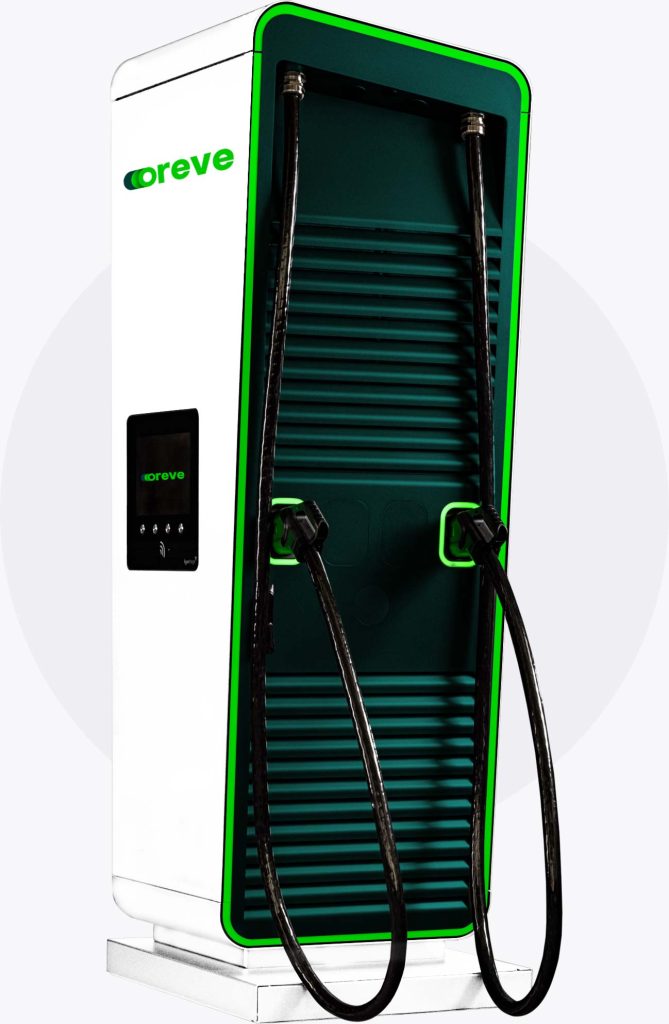
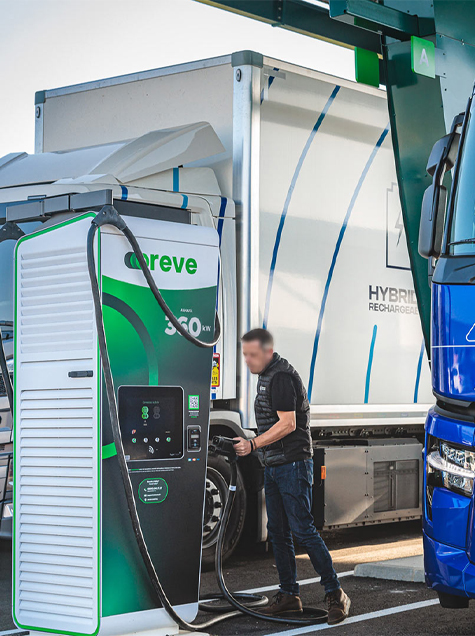
Oreve stations are designed to accommodate all types of vehicle, from small city cars to heavy goods vehicles.
Do light vehicles and heavy goods vehicles share the same charging zone?
No, each station includes a specific area dedicated to charging HGVs and another reserved for light vehicles. This guarantees the safety of all our users.
Are Oreve stations suitable for both private and professional users?
Absolutely. Oreve stations are designed to meet the needs of both professionals and private individuals, enabling everyone to recharge their vehicles in complete peace of mind and safety.
The Oreve mobile application offers a number of advantages:
- Start and stop charging directly from your smartphone
- Find out in real time about the availability and characteristics of charging points
- Monitor charging progress and information in real time
- Retrieve your charging history and invoices
How do I download the application?
- 📱 With an Android phone
You can download our free application from Google Play.
- 📱 With an iPhone
You can download our free application from the AppStore.
Once you have chosen a payment method, there is one final step to be completed before you can start charging: prepayment.
The prepayment is a sum temporarily blocked by the bank, guaranteeing that the necessary funds (or an authorised overdraft) are available for the transaction. This pre-authorisation amount is set at €49 or €149 for light or heavy vehicles at our Oreve stations.
The pre-payment is a pre-authorisation and not a final payment. Although some banks show this amount as debited, it generally disappears after a few days or is cancelled by an equivalent credit (depending on your bank). The time taken to return the money depends on your bank and is beyond our control.
Why do I see two transactions on my bank statement?
Only the exact amount of the charge will be debited, but it is possible that two transactions will temporarily appear: the prepayment of €49 or €120 (depending on the vehicle) and the final payment. If several attempts have been made to start the charge, each attempt may generate a new pre-authorisation and therefore result in several bank prints on the account. These pre-authorisations are independent of the success of the charge.
What happens if there are insufficient funds for the pre-payment?
If the account does not have sufficient funds for the pre-authorisation, the transaction will be refused without the amount being debited.
Oreve stations offer a wide range of services to maximise user comfort: a relaxation area, free Wi-Fi, drinks and sweets dispensers, sanitary facilities and photovoltaic shading for added convenience.
The power, and therefore the charging speed, of an electric vehicle can be affected by a number of factors. This explains why the maximum power available from a charging point is not always the power actually used during the charging session.
The maximum charging speed of an electric vehicle depends on a number of factors:
Technical limits of your vehicle
For example, a Peugeot e-208 can reach a maximum power of 100 kW, while a Tesla Model 3 can go up to 170 kW. We recommend that you consult your vehicle’s manual or your dealer to find out the maximum authorised charging power.
Outside temperature
The ambient temperature has a significant impact on the power and therefore the charging speed of a battery. If it is too cold or too hot, charging performance may be reduced. Some top-of-the-range cars have a battery preconditioning system that allows the optimum charging temperature to be reached, generally between 20°C and 30°C.
Sharing the chargepoint’s power
When two vehicles charge at the same time from the same charging point, the total power available is shared between them, which can reduce charging speed.
For further information, please contact us by e-mail at [email protected]
As a general rule, the rate of charge decreases significantly once the battery reaches 80% of its capacity. This phenomenon can be explained by the physical properties of the battery cells. It can be compared to filling a bottle with water: initially, the water flows freely, then as the bottle fills up, the flow decreases. The same applies to a battery: it will take you longer to recharge your battery from 80% to 100% than from 20% to 80%.
Select the connector on the terminal
Make sure the connector number matches the one displayed on the screen.
Swipe your badge through the terminal reader
You will hear a ‘beep’ confirming the transaction. If this is not the case, swipe your badge again.
Plug the connector into your vehicle
Charging will begin within 30 seconds.
Select the connector on the terminal
Check that the number matches the one displayed on the charger screen.
Approach the terminal with your payment card or application
Hold your contactless bank card or smartphone up to the terminal.
Connect the connector to your vehicle
Charging will start automatically after about 30 seconds.
Download your proof of payment from our dedicated platform. Simply enter the date of your charge and the last 4 digits as well as the validity date of the bank card used for payment.
